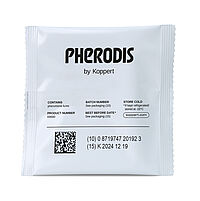
PHERODIS
species-specific pheromones
PHERODIS
species-specific pheromones
Packaging unit:
Packs of 4 pheromone dispensers with a species-specific sex pheromone (see text on pack)
Order separately:
Deltatrap: pack containing trap(s), adhesive plates, and suspension hooks
The following pheromones are available for moths:
Adoxophyes orana
Agrotis segetum
Agrotis ipsilon
Anarsia lineatella
Autographa gamma
Cacoecimorpha pronubana
Cameraria ohridella
Ceratitis capitata
Chilo suppressalis
Chrysodeixis chalcites
Clepsis spectrana
Cossus cossus
Cryptophlebia leucotreta (Thaumatotibia leucotreta)
Cydia funebrana
Cydia pomonella
Cydia pyrivora
Cydia splendana
Cylas formicarius elegantul
Dacus oleae
Duponchelia fovealis
Eupoecilia ambiguella
Euzophera punicaella
Grapholita lobarzewskii
Grapholita molesta
Helicoverpa armigera
Heliothis virescens
Keiferia lycopersicella
Lacanobia oleracea
Lobesia botrana
Mamestra brassicae
Musca domestica
Operophtera brumata
Opogona sacchari
Ostrinia furnacalis
Ostrinia nubinalis(EZ-strain)
Pandemis heperana
Pectinophora gossypiella
Phtorimaea operculel
Phyllonocyter corylifoliella
Phyllonorcyter blancardella
Plodia / Ephestia
Plutella xylostella
Prays oleae
Rhagoletis cerasi
Riptortus clavatus
Sesamia nonagrioides
Spodoptera exigua
Spodoptera littoralis
Spodoptera litura
Symmetrischema tangolias
Synanthedon myopaeformis
Synanthedon pyopaefo
Synanthedon tipuliformis
Tecia solanivora
Thaumetopoea processionea
Thaumatotibia leucotreta (Cryptophlebia leucotreta)
Trichoplusia ni
Tuta absoluta
Vitacea polistiformis
Zeuzera pyrina
For beetles:
Rhynchophorus ferrugineus
For mealy bugs:
Planococcus citri
Use
Detection of butterflies/moths, beetles or male winged mealy bugs inside greenhouses or outdoors.
Quantity to be used
For every species of butterfly/moth that may be present, use 2-4 dispensers per hectare; for mealy bugs, 1 dispenser per 500 - 1000 m²
Method
Assemble the desired number of pheromone traps as described under “Assembly of Deltatrap”. Collect the sachets containing the pheromone dispensers from the cold store and open the sachets. Do not touch the capsules, since hand contact for example can spread the pheromone to other areas in the glasshouse. Lay the capsule on the adhesive plate of the Deltatrap and hang the trap in a suitable position. Hang the traps about 10 centimetres above the plants in a location where they can be inspected regularly (for example along the concrete aisle). Distribute the traps as evenly as possible over the surface area in order to avoid mutual interference.
IMPORTANT:
Never open the “plastic tube” type of pheromone capsules since otherwise the pheromone will be spent within a few days. The plastic tube is permeable, and the pheromone will gradually diffuse through the wall.
Storage and treatment
Pheromone capsules (and the sachets containing them should preferably be kept in a freezer (-18°C), and in any case at temperatures below 4°C.
The production date is printed on the packs. The capsules have a shelf life of 2 years after the production date when stored in a freezer, and 1 year when stored in a refrigerator (4-6°C).
Comments
Assign each Deltatrap a serial number. Note the trap’s serial number and the type of pheromone it contains on the outside.
Wash your hands between assembling pheromone traps for different species of butterflies and moths.
During the first few days following the installation of a new pheromone capsule, more moths or butterflies may be caught than usual. This is due to the temporarily greater release of the pheromone from the new capsule.
Pheromone capsules remain effective for 6 weeks after being hung up in the trap/Deltatrap. Replace the capsule after 6 weeks, only with capsules containing the same kind of pheromone.
Mode of action
The capsules release the scent of a species-specific sex pheromone. This scent lures adult males of the species of pest concerned into the trap. There they become stuck to the adhesive plate, making them easy to detect, count and identify.
Important:
The quantity of this product used should be adjusted according to the effect of the product and the expected results in the crop concerned. For the correct approach, please consult a Koppert specialist or a recognised distributor of Koppert products.
Natural progression