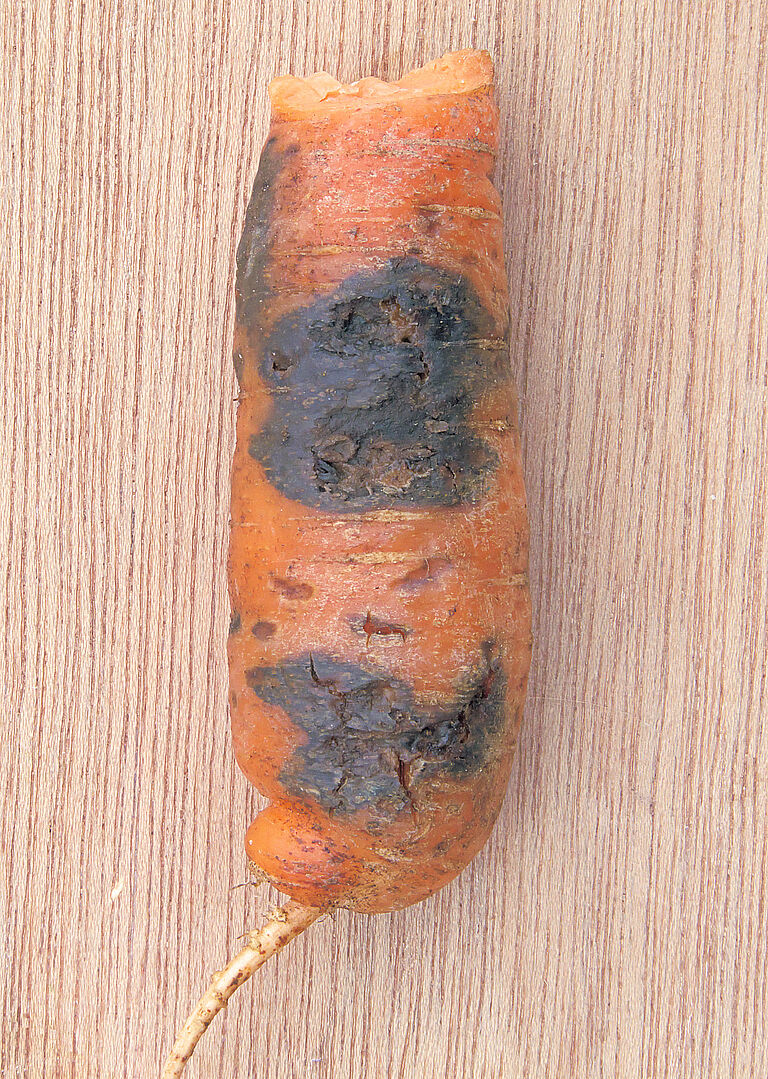

Damage symptoms
Rhexocercosporidium carotae is a slow-growing fungus that can infect both roots and foliage. The infection starts with small black spots over the entire surface of the carrot. These spots gradually change into larger dark brown to black lesions of various shapes. The lesions can merge and eventually cover the entire surface of the carrot. The affected areas are firm, shallow, and clearly visible. Under certain conditions, an olive-green mycelium can develop on the surface.
Initially, the disease forms circular to irregular spots on the leaves that vary in colour from grey to almost black. The spots appear to be sharply defined, but under a magnifying glass it appears that the infected area radiates into the healthy tissue. The spots can increase in number and size until they merge, after which whole sections of the leaf will die off. The fungus appears to prefer older tissue.
In the field, the disease is difficult to distinguish from both Cercospora and Alternaria dauci. Cercospora prefers younger leaves. A. dauci starts mainly along the leaf edges. Rhexocercosporidium infection can cause loss of seedlings. The subsurface parts turn dark brown to black, while the cotyledons remain green. During humid spells the surviving plants exhibit by necrotic leaf spots
