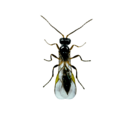
FAQs Nezapar 1. Nezapar (Trissolcus basalis) What is the appearance of Trissolcus basalis? Adults are black wasps of about 1-3 mm length with downward [...] interval than 1 week after introduction? No, avoid development of Nezara at all times. When do I need to increase the dosage? When you observe 1 adult or nymph [...] bugs are expected. Introduction rates preventive: 10 000 wasps/ha = 2 tubes (1 wasp/m²/week) light curative: 30 000 wasps/ha = 6 tubes (3 wasps/m²/week) heavy
in colour with black bristles and colourless wings. The elongated eggs are 1.2 mm in size and white in colour. The larvae are white or whitish-yellow, 7-10
narrow, clear wings with clearly visible veins. Eggs are black in colour, oval, 1mm long and deposited on the soil surface. Larvae are cylindrical, tapering
obstruction ring Timing Place the traps at the edge of the premise, at a height of 1 to 2 meters Combined use For intensive monitoring place multiple traps with
trap and dispenser just above (max. 30 cm) the top of the plants Dosage Use 1 dispenser per 100 m 2 Replace after 6 weeks Combined use Use in combination
nymphs and adult females are oval and covered by wax. The adult female is 1.7-3.3 mm long.
and the males are considerably smaller than the females.The eggs are about 1 mm long; oval and pinkish orange. The larvae are up to 60 mm long and bright
Their development is very rapid if the conditions are favourable and a further 1-2 generations may be completed in the same season. The pupae overwinter in
species Steinernema feltiae . Nematodes are microscopically small (0.6 to 1 mm), unsegmented worms that occur naturally in the soil throughout the world
funnel with a twist action lining up the slots Application Place trap on a 1 metre stick Place one trap on the north edge and one trap on the south edge