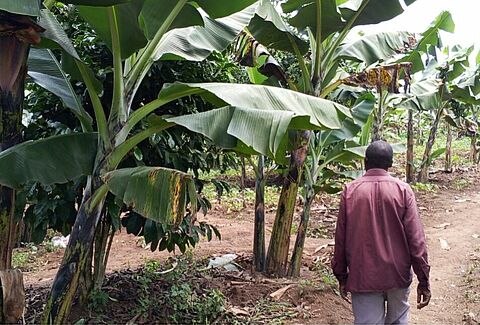
Success story: Musinguzi's Matooke Enterprise
The Barren Plot and a Fading Dream
In Kihanga Village, Bugaaki Parish (Uganda), 45-year-old father Musinguzi Robert looked upon his one-acre plot with a sense of profound frustration. For years, he had tried to cultivate the land passed down from his father, but it yielded little more than struggle. His primary crop, maize, was a constant gamble. Erratic rains would either drown the young shoots or abandon them to a scorching sun, leaving the stalks stunted and the cobs sparse. The income from a 'good' season was barely enough to cover basic necessities, let alone the school fees for his three children or the repairs his modest home desperately needed.
Musinguzi had always dreamt of establishing a proper banana plantation: a 'matooke' garden. In his culture and region, a thriving banana plot was more than a crop; it was a symbol of stability, a source of daily food, and a reliable income generator. He had seen how his more fortunate neighbours depended on their steady banana harvests. However, the dream felt impossibly distant. A single high-quality, disease-resistant banana sucker from an approved nursery cost more than he could afford to risk. To plant a full plot would require hundreds of them, an investment far beyond his means. Furthermore, he lacked the technical knowledge of proper spacing, pest management, and soil nutrition specific to bananas. His dream remained just that a dream while his family's food and financial security remained precarious, tied to the unreliable fate of annual maize.
The intervention: 200 suckers and a new foundation
The turning point came in late 2024 when KAWODA, in collaboration with Koppert Foundation, rolled out its 'High-Value Perennial Crops Programme.' This initiative aimed to transition farmers from vulnerable seasonal crops to resilient, nutrient-dense, and economically viable perennial farming systems. Musinguzi, known in his village as a hardworking yet struggling farmer, was nominated by the local council to be a beneficiary.
The intervention was comprehensive. First, Musinguzi and 20 other selected farmers from Bugaaki Parish attended a week-long training at the parish headquarters. KAWODA's Agricultural extension officer did not just lecture, he facilitated hands on learning. Musinguzi learned how to
- Prepare land for bananas using deep, wide planting pits refilled with a mix of topsoil and well-decomposed organic manure.
- Identify and select healthy, tissue-culture banana suckers free of weevils and nematodes.
- Apply the correct spacing to allow for growth and air circulation, preventing disease.
- Implement Integrated Pest Management (IPM) using eco-friendly methods like trapping banana weevils and applying ash around the stems to deter borers.
- Practice nutrient cycling by mulching heavily with dried grass and banana leaves to retain soil moisture and add organic matter.
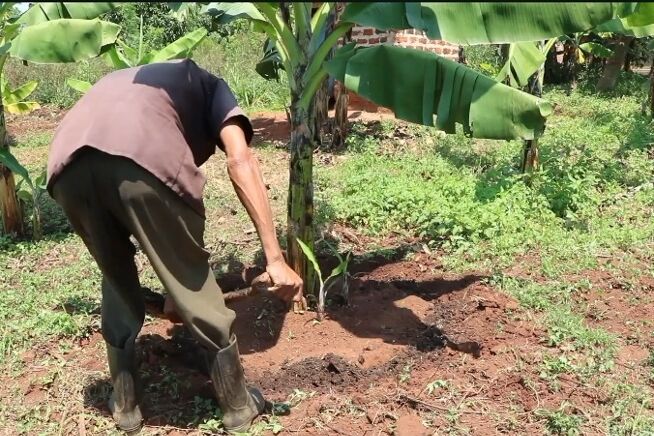 Musinguzi using organic manure in his banana plantations
At the end of the training, the transformative moment arrived: Musinguzi was given a consignment of 200 certified disease-resistant banana suckers. A KAWODA field officer accompanied him to his plot. Together, they pegged out the entire acre, marking 200 precise spots. Over the next five days, with his family's help, Musinguzi dug each pit, mixed in the manure, and carefully planted each sucker, treating it as the seed of a new future.
The transformation: A green canopy and a steady harvest
Seventeen months later, Musinguzi's farm is a landmark in Kihanga Village. Where there was once exposed, struggling earth, now stands a magnificent, green canopy of thriving banana plants. The leaves are broad and lush, a testament to the healthy soil beneath. The first bunches of matooke have been harvested, with heavy, green fruits promising both nourishment and income.
The impact is measurable and profound:
- Food security achieved: For the first time, Musinguzi's family has a permanent, reliable source of staple food. A mature banana plantation cycles, meaning there is almost always a bunch ready for the pot. The anxiety of 'hunger months' has vanished from his household.
- Economic resilience built: Last month, Musinguzi harvested and sold his first seven commercial bunches at the Kyembogo produce market. The income was more than he typically made from an entire season of maize. He opened a dedicated savings account, where he deposits funds from each sale. This money is a direct investment in his children's education and his family's wellbeing.
- Knowledge and status transformed: Musinguzi is no longer just a beneficiary; he is a model farmer. He expertly demonstrates desuckering (removing extra shoots to maintain plant vigour) and proper propping of heavy banana stems to his neighbours. The sub-county agricultural officer has designated his garden as a 'farmer learning site' and groups from other parishes now visit to learn.
- Ecological benefits realized: The banana garden acts as a mini-ecosystem. The thick mulch conserves water, suppresses weeds, and enriches the soil. The shade cools the micro-climate. He has intercropped the young plantation with beans, which fix nitrogen in the soil, creating a sustainable, multi-storey farming system.
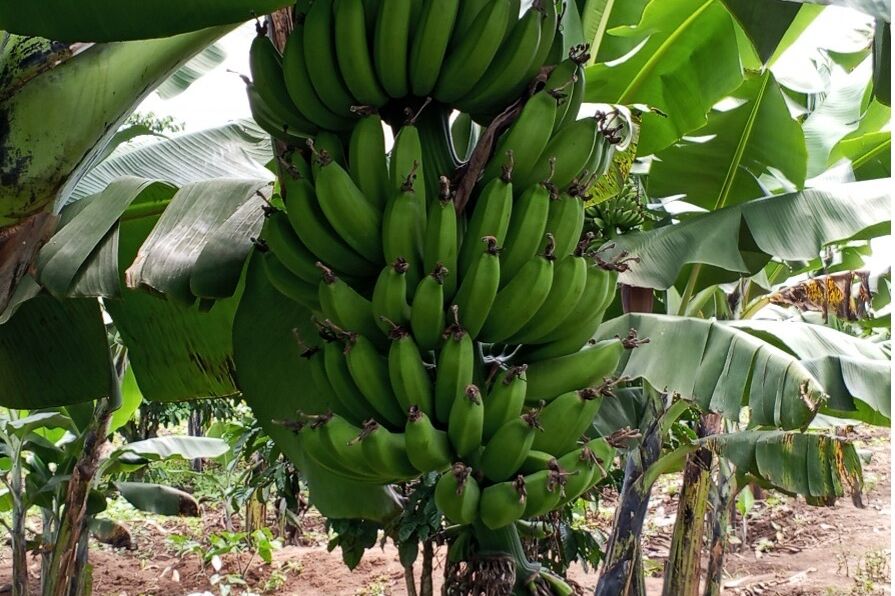
"Before KAWODA, I was digging for survival," Musinguzi reflects, standing proudly under the shade of his own plants. "Now, I am farming for the future. These 200 suckers were not just plants; they were 200 keys that unlocked my land's potential. I am not just harvesting bananas; I am harvesting hope for my children's education, security for my family, and respect from my community. This garden is my greatest asset."
Koppert Foundation's provision of quality planting material paired with in-depth knowledge enabled Musinguzi to convert a dream into a living, productive reality. His story is a powerful testament to how supporting the establishment of high-value perennial crops can create irreversible, positive change, turning a struggling farmer into a pillar of food security and economic stability in Kyembogo sub-county.